- Home
- About
- Services
- Resources
- Do You Need a Permit to Remove a Tree in Manatee County
- Do You Need a Permit to Remove a Tree in Sarasota County
- Bradenton City Tree Removal Permits
- Florida Tree Removal Law 163.045
- What Tree Removal Costs in Manatee and Sarasota County
- Palm Tree Trimming Cost in Bradenton, Florida Guide
- Bradenton Hurricane Tree Prep
- Tree Topping in Florida
- Is Your Tree Dangerous? Warning Signs in Bradenton, Florida
- Live Oaks in Manatee County: Protected, Pruned and Misunders
- Florida Palm Tree Care | Sabal, Queen, Coconut and Date
- Storm Damage Tree Removal and Insurance in Bradenton
- Signs of Tree Decline in Florida
- Florida Tree Service Checklist
- Service Areas
Bradenton, FL
Samoset, FL
Palmetto, FL
West Bradenton, FL
Oneco, FL
Bayshore Gardens, FL
Ellenton, FL
Memphis, FL
Whitfield, FL
Palma Sola, FL
Terra Ceia, FL
Longboat Key, FL
Cortez, FL
Rubonia, FL
Bradenton Beach, FL
Holmes Beach, FL
The Meadows, FL
Sarasota, FL
Anna Maria, FL
Parrish, FL
Fruitville, FL
Lakewood Ranch, FL
Sarasota Springs, FL
Bee Ridge, FL
Lake Sarasota, FL
Siesta Key, FL
Gulf Gate Estates, FL
- Contact
Tree Health and Disease Treatment in Manatee and Sarasota County
A tree that looks sick does not always have to come down. A thinning crown, yellow fronds, dieback, conks at the base or a lightning scar can mean anything from a nutrient problem that is easy to correct to a disease with no cure, and the difference decides whether you spend money on treatment, pruning, patience or removal. Stillman’s Tree Service has worked across Manatee County and north Sarasota County for twenty years, family owned and owner operated, licensed and insured. We look at the tree for free and tell you what it is doing, what can be treated and what cannot. If it can be saved, we say so. If it cannot, we say that too.
What Tree Health and Disease Treatment actually involves
Reading the symptoms
Trees and palms show stress in a small number of ways: a thinning crown, dieback at the tips, yellowing or browning leaves and fronds, early fruit drop, cracked or oozing bark, and fungal growth at the base. Many different problems produce the same symptoms, so the pattern matters: which leaves, which side of the tree, how fast, and what changed on the property. A palm with yellow lower fronds and a palm with a blackened flower stalk look alike from the street and are very different problems. Some diseases need a lab test to confirm, and the estimate says when one is worth doing.
Lethal bronzing and Fusarium wilt in palms
Lethal bronzing is caused by a phytoplasma carried from palm to palm by an insect. It affects Sabal, queen, date and some coconut palms. The first signs are early fruit drop and flower stalks that blacken, then fronds that turn bronze or brown from the oldest up, until the new spear leaf collapses. Once those symptoms show, the palm cannot be saved. What can be done is remove the infected palm and protect healthy palms nearby with preventive trunk injections, repeated on a schedule. Fusarium wilt, best known in Canary Island date palms, is a fungus that spreads on infected pruning tools and in soil.
Decay fungi and butt rot
Ganoderma is a fungus that rots the lower trunk and the roots. In palms, Ganoderma butt rot is fatal and has no cure, and the conk at the base appears late, after the decay is well along. In oaks and other hardwoods, a bracket conk at the base means decay in the root crown and butt, and the question is how much sound wood is left to hold the tree up. A tree with a small area of decay inside a wide ring of sound wood can be watched. A trunk that is mostly hollow cannot, and it becomes a risk to whatever stands beneath it.
Root and soil stress
Most declining trees here are not diseased. They are stressed at the roots. Construction compacts soil so water and oxygen cannot reach the roots. Fill piled over the root zone, trenching for irrigation or utilities, and pavers laid close to the trunk cut roots or smother them. Sandy soil holds few nutrients, so palms often show potassium, magnesium or manganese deficiencies as yellow or frizzled fronds, which is why a yellowing palm should not be cut back. See palm tree trimming. On the island towns, salt spray and standing water after storms add stress.
Lightning strike and storm wounds
Lightning is a real cause of decline here. It can strip a ribbon of bark down the trunk, or leave no mark outside and damage the living layer and the roots underneath, so a struck tree can look fine for weeks and then fade. A palm struck at the crown can lose its single growing bud. The right response is usually to wait and watch before deciding anything. Storm wounds are different. Torn bark and broken limbs are cut back cleanly so the tree can wall off the wound, and a tree that has lost a limb but not its structure often recovers. A split in the main trunk or at a union is a structural problem, not a health problem.
What is treatable and what is terminal
The honest answer depends on the cause.
| Problem | Can it be treated? |
|---|---|
| Lethal bronzing in a palm | No, once symptoms show. Healthy palms nearby can be protected. |
| Fusarium wilt in a Canary Island date palm | No cure. The palm is removed and tools are cleaned between palms. |
| Ganoderma butt rot in a palm | No cure. |
| Decay fungi in an oak or other hardwood | Depends on how much sound wood is left. |
| Nutrient deficiency in a palm | Yes, it can be corrected. |
| Root and soil stress | Often, when the cause is found early. |
| Lightning strike | Some trees have recovered. Wait and watch. |
| Storm wounds | Often, with clean pruning cuts. |
When it is the right answer and when it is not
Treatment is the right answer when the tree or palm is still alive and the cause can be corrected:
- A thinning or yellowing crown where the cause can be found and fixed, whether it is nutrients, roots or pests.
- A tree or palm hurt by lightning or a storm that still has sound structure.
- Healthy palms near an infected one, where prevention can still help.
- Soil stress after building work, paving, fill or trenching.
It is not the right answer, and we will say so, in these cases:
- The tree is dead. Treatment does not bring back wood that has died.
- A palm has lethal bronzing, Fusarium wilt or Ganoderma butt rot. It cannot be saved, and the answer is tree removal, with protection for any healthy palms nearby.
- The trunk is hollow, split or mostly decayed. Treatment does not restore wood, and a tree in that condition is a risk to whatever stands beneath it. If removal is the answer, see the Florida Statute 163.045 note under Permits.
- The problem is structure, not health. A heavy limb or a crowded crown is a tree trimming job, and a tree that can be pruned does not need to come down.
- Waiting is the answer. A lightning-struck tree is often better watched than treated, and we will say so before we sell you anything.
- A tree is leaning or has come down on a structure after a storm. Call for emergency tree service first, and look at health once the site is safe.
- We do not sell treatment a tree does not need. If the answer is to water, wait or do nothing, the estimate says so.
How the job runs
Free estimate
We look at the tree or palm, the roots and soil, what has changed on the property, and the pattern of symptoms.
What we think it is
We tell you the likely cause and how sure we are. If a lab test is needed to confirm a disease, we say so before anything else happens.
Your options
Treat, prune, wait or remove, each with its cost and what to expect. Nothing starts without your eyes.
Treatment
Where treatment is the answer, it is carried out as agreed. Some treatments repeat on a schedule, and the estimate says which. Stillman's is family owned and owner operated, and the crew works to the scope you were given.
Follow-up
Trees recover slowly, so we say what to watch for and when to call.
Treatment is measured in seasons, not days. A response shows over months, and the estimate says what to expect and when to look at the tree again.
What it costs
Most tree health and disease treatment jobs in Manatee County fall between $150 and $2,500. Where yours lands depends on:
Number of trees or palms
Several in one visit are usually priced better each than one on its own.
Size
A large oak and a small palm are different jobs.
The cause
A nutrient problem and a disease are treated very differently.
Testing
Some diseases need a lab test to confirm, and the estimate says when.
The treatment
What is applied, and how often, moves the price.
Repeat visits
Some treatments repeat on a schedule, and the estimate shows the full course, not only the first visit.
Related work
Pruning dead wood or removing a tree that cannot be saved is priced separately.
A single small palm needing a nutrient correction sits toward $150. Several large trees on a repeat course sit toward $2,500. The estimate is free, and so is a straight answer that nothing needs doing. If another quote sells you treatment for a palm already showing lethal bronzing symptoms, ask what it expects to change. Stillman’s carries General Liability and Workers Compensation, and the certificate is available on request.
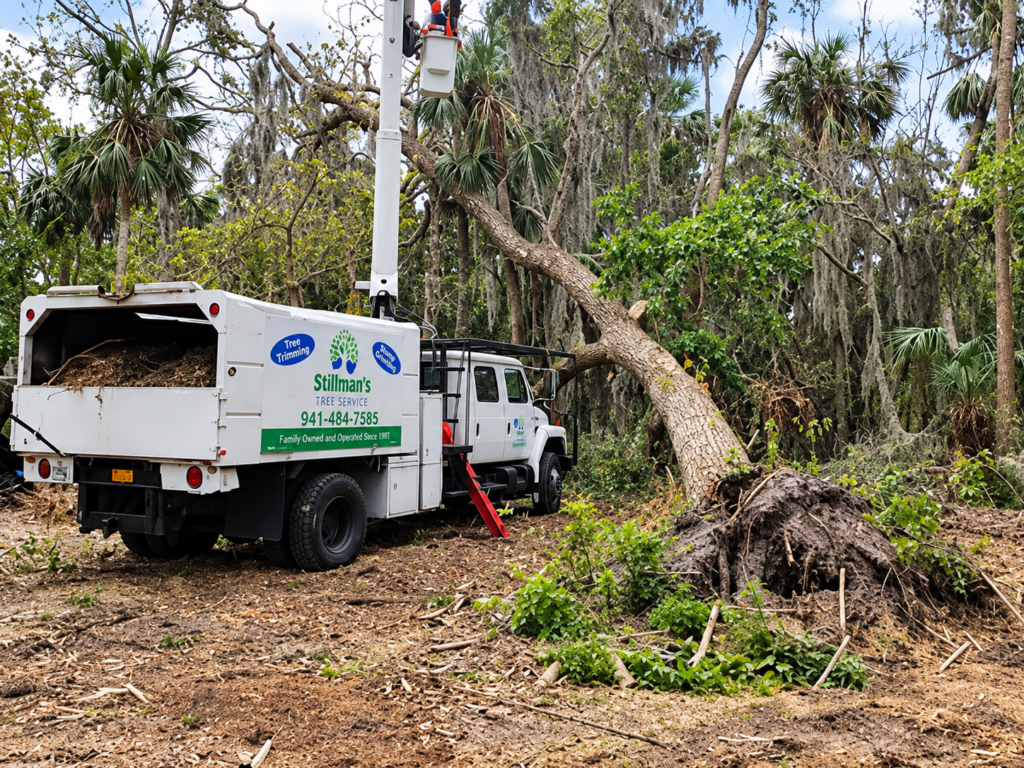
Permits
Treating a tree usually does not need a permit, but removing one can, and the rules differ between Manatee County, Sarasota County and the City of Bradenton. Some trees, live oaks among them, are protected in places. Start with the page for your jurisdiction: Manatee County tree permits, Sarasota County tree permits and City of Bradenton tree permits.
Florida Statute 163.045 matters when the honest answer turns out to be removal. It limits what a local government can require for a residential tree that poses an unacceptable risk, but only with the right documentation. It is not a way around every permit for every tree. Stillman’s can sign that documentation, and the estimate costs nothing. See the Florida Statute 163.045 page.
Where we work
Tree health and disease treatment is one service across the whole territory, with no separate town pages, so this is the full statement of coverage. Stillman’s works from its yard at 2509 9th St W in Bradenton and serves 28 communities within about 15 miles, across Manatee County and north Sarasota County, including Bradenton, Palmetto, Ellenton, Parrish and Lakewood Ranch, along with {COMMUNITY_LIST}. What stresses a tree changes with the neighborhood. On the island towns it is salt and standing water after storms, inland it is sandy soil and compacted ground around new construction, and everywhere it is lightning in summer. For a tree that has to come down, see tree removal.
Tree Health and Disease Treatment FAQ
Can a dying tree be saved?
Sometimes. It depends on the cause. Root stress, nutrient problems and storm wounds are often treatable, while a dead tree or a hollow, mostly decayed trunk is not. The estimate is free and tells you which you have.
Can a palm with lethal bronzing be saved?
No. Once symptoms show, the palm cannot be saved. The palm is removed, and healthy palms nearby can be protected with preventive treatment.
How can I tell if my palm has lethal bronzing?
The usual signs are early fruit drop, flower stalks that blacken, and fronds that turn bronze or brown from the oldest up. A lab test confirms it. Yellow lower fronds alone are more often a nutrient problem.
What is the difference between lethal bronzing and Fusarium wilt?
Lethal bronzing is a phytoplasma spread by an insect and affects several palm species. Fusarium wilt is a fungus best known in Canary Island date palms, spread on infected tools and in soil. Neither can be cured once a palm is infected.
Why is my palm turning yellow?
Often it is a nutrient deficiency, which sandy soil makes common. Cutting the yellow fronds takes away nutrients the palm is still pulling from them. A look at the palm tells you whether it is nutrients or something more serious.
My tree was hit by lightning. Will it die?
Not always. Lightning can leave a visible scar or no mark at all, and a struck tree can look fine for weeks before it fades. We usually watch it for a season before deciding anything.
What is the conk growing at the base of my tree?
It is the fruiting body of a decay fungus, and it means decay in the roots or lower trunk. How serious it is depends on how much sound wood is left. In a palm, Ganoderma butt rot is fatal.
Why is my tree declining after construction?
Construction compacts soil, buries roots under fill and cuts them with trenches, and the tree shows it months or years later. Correcting the cause early gives the tree the best chance.
How much does tree health and disease treatment cost?
Most jobs fall between $150 and $2,500. The price moves with the number of trees, their size, the cause, any testing, the treatment and whether it repeats on a schedule.
Do you charge to look at a sick tree?
No. The estimate is free. Stillman’s does not charge to look at a tree, and you get the options and prices before any work is scheduled.
Get a free estimate
Call Stillman’s Tree Service at 941-803-1309 and tell us which tree or palm it is and what it is doing. The estimate is free, it comes before any work, and if the answer is to wait, water or do nothing, that is what we will tell you. Stillman’s Tree Service, 2509 9th St W, Bradenton, FL 34205. Family owned and owner operated for twenty years, licensed and insured.